The founder isn't the bottleneck. The lack of a decision system is.
Companies don't slow down because they lack people. They slow down because of the queue to the founder. How to build a Minimum Viable Control System before chaos becomes the default way of working.
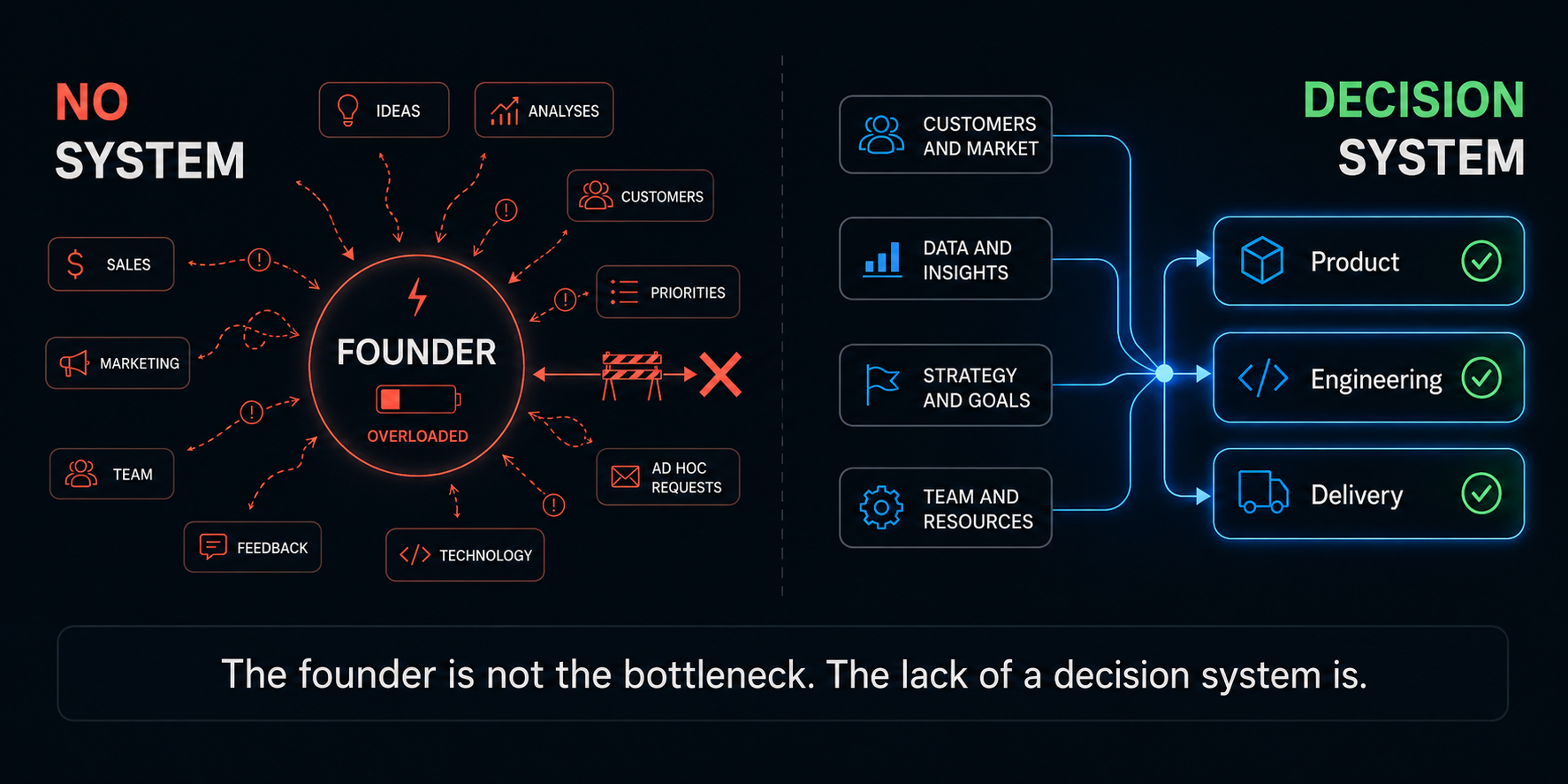
At the beginning, the founder is an advantage. They decide faster than any process, see more than the team, and keep strategy, clients, roadmap, risks, and product context all in their head. The problem starts when the company grows, but the way decisions are made stays exactly the same. The founder is still the best source of decisions — but they’ve also become the most expensive queue in the company.
The problem doesn’t start when the founder makes bad decisions. It starts when only the founder can make them.
At first, the founder is the company’s operating system
In a small tech company, the founder is the strategy, roadmap, escalation path, decision log, and quality filter all in one. It works. It gives speed, consistency, and a direct connection to reality.
But then the company hires. A second person, a third, a team. It takes on bigger projects, new clients, more cross-functional dependencies. And the way things work stays the same. The founder still holds everything in their head — strategy, priorities, trade-offs — as if the organization hadn’t grown at all.
For a while it’s manageable. But the ceiling is hard. Not because the founder is weak. Because one brain has finite bandwidth, and the volume of decisions grows at a rate you can’t scale by sheer willpower.
If the roadmap exists mainly in the founder’s head, the company doesn’t have a roadmap. It has one person’s working memory.
Companies don’t slow down because they lack people. They slow down because of the queue to the founder.
The problem doesn’t look like chaos. It looks exactly like this: we’re waiting on a decision.
R&D is waiting on a feature priority. Product is waiting on a scope change. Hardware is waiting on a component decision. Software is waiting on architecture. The supplier is waiting on confirmation. Sales is waiting on messaging for clients.
The founder isn’t a bad leader. They’re overloaded.
But organizationally, that doesn’t matter. If decisions can’t be made without the founder, the company has a speed limit set to one person’s availability. Not their talent. Their availability. Their calendar.
This isn’t a function of effort. It’s architecture.
Companies don’t slow down because they lack people. They slow down because of the queue to the founder.
When the founder’s advantage turns into a cost
Product decisions start blocking delivery. The roadmap stops being the source of truth — every team has their own version. R&D builds on assumptions instead of data. Sales makes promises before assessing delivery impact. Compliance and production wait for a signal that never comes.
The founder becomes a dispatcher instead of a CEO. Answering questions instead of setting direction.
The organization shifts from proactive to reactive. Every decision requires escalation. Queues grow longer. Teams get frustrated.
The most expensive cost of founder bottleneck isn’t that a decision lands late. It’s that the organization learns not to decide without the founder.
In HW+SW products, this problem hits faster
In pure SaaS, a bad decision means a refactor, hotfix, or rollback.
In HW+SW it goes into the component, supplier, production, installation, compliance, service, and end client.
- R&D doesn’t know which version of requirements is final — they build in parallel toward two targets.
- Production loses a week waiting for a component change decision.
- The supplier is working off information that’s two weeks old.
- The client gets a promise before anyone’s assessed delivery impact.
- Software and hardware have different definitions of “done.”
- Compliance and service find out too late.
- The roadmap changes after conversations that never make it into any system.
This isn’t a lack-of-process problem. It’s a lack of control over decisions that carry operational cost.
Founder Bottleneck Test
Check where you stand:
- Important product decisions wait on the founder for more than 48–72 hours.
- The team knows the founder’s preferences but not the decision-making rules.
- The roadmap changes after conversations that don’t appear in the backlog, decision log, or delivery plan.
- A client or sales team gets a promise before the team, timeline, or scope impact has been assessed.
- The founder is the only person who can explain why something is really a priority.
If 3 out of 5 are true, the problem isn’t a missing tool. The problem is that the company has no scalable decision mechanism.
Minimum Viable Control System
The system doesn’t replace the founder. It does something different: it moves repeatable decisions from the founder’s head into the organization. The founder still decides on direction. But they stop being the manual router for every change, escalation, and dependency.
What you actually need:
- Decision types and their owners — who decides what, when, and based on what.
- A single source of truth for the roadmap — if a priority changes, everyone sees it in the same place.
- A decision log — a decision must leave a trace. Not in Slack, not in emails, not in the founder’s head.
- A change intake process — what falls off the plan when something new comes in. A question that has to be asked every single time.
- A regular priority review rhythm — scheduled, not ad hoc.
- Clear definitions of “done” — separately for HW, SW, delivery, compliance, and service.
You don’t need SAFe. You don’t need a PMO. You don’t need thirty statuses in Jira.
You need answers to four questions: who decides, when they decide, what they base that decision on, and what falls off the plan when the decision shifts priorities.
Most companies don’t scale process too late. They scale chaos for too long.
First three moves
Move 1: Map the decisions that currently run through you
Not processes — decisions. For the next week, note down: what’s blocking the team? What needs your approval? What keeps coming back?
Move 2: Separate strategic from operational
You own direction, strategic trade-offs, big risks. You don’t have to be the one person handling every scope change, priority shift, and dependency. That’s the first thing that has to change when an organization scales from fifteen to forty people.
Move 3: Introduce a single source of truth
If a decision changes the plan, it has to be visible in the system — in the same place everyone looks.
If a decision doesn’t leave a trace in the system, the organization hasn’t made it. Someone just talked about it.
Most founder-led companies don’t notice the moment when speed turns into manually steering the entire organization.
Product Control Review shows where a company is losing control over decisions, roadmap, change, and delivery — before chaos starts being treated as a normal way of working.
If 3+ points from the Founder Bottleneck Test are true for you, it’s worth checking where decisions have stalled in your organization.